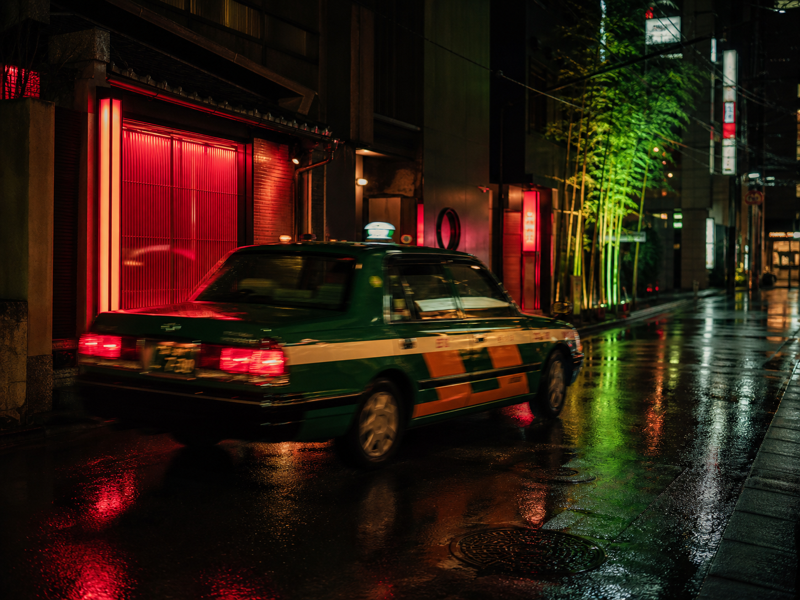
Osaka doesn't perform for tourists the way Tokyo does — which is exactly why it's cheaper, warmer, and easier to get burned in if you can't read the room. We counted the reports so you can.
Osaka is the friendliest nightlife city in Japan and the one with the highest tout density in the country, and those two facts live one street apart in Dotonbori. The difference isn't luck. It's information — a handful of numbers and one Japanese sentence that the locals absorb by osmosis and visitors learn the hard way, usually around 1AM, usually near an ATM.
This report is that information, organized. We read the review boards so you don't have to, and we turned the noise into the only thing that matters at the door: the all-in number, before you sit down.
— WHY WE MADE THIS —
FREE · 01The one insight that pays for this report
Across every category we tracked, the visitors who got burned had one thing in common: they let the meter start before the price was spoken. The ones who had a great night said eight words at the door — 「料金は全部でいくらですか?」 — and listened for a number, not a smile.
A venue that answers in a figure is a venue you can plan around. A venue that answers in "don't worry" just quoted you its most expensive price. That single filter removes the overwhelming majority of Tokyo nightlife horror stories — and it's free, so use it whether or not you read another word.
"Below this line, we stop talking about principles and start naming numbers."— THE PART YOU CAME FOR
Read the rest of the night.
The free half told you the principle. The paid half is the receipts — named, priced and dated.
- The all-in median for 6 nightlife formats, with ranges & report counts
- Which specific doors reviewers say actually welcome foreigners
- The 5 Japanese lines that get you a price, a seat, and a graceful exit
- The Kabukicho & Shibuya tout map — where the surprise bills live
- 90 days of updates as prices and doors change
Secure card checkout · Seller details on the legal page · 18+
MEMBER · 02The bill, by category
Medians visitors reported paying this quarter, by format. Every figure is an editorial estimate drawn from aggregated public reports — a starting expectation, not a quote. Confirm at the door.
| Club (Circus / Joule tier) door + 1–2 drinks | ¥4,300 ¥3.5–6K | FIXED · SAFE |
| Girls bar / kyabakura first hour, careful | ¥11,000 ¥7–23K | ASK FIRST |
| Kitashinchi hostess club per hour, introduced | ¥30,000 ¥20–50K+ | EXPENSE ACCT |
| Men's esthe 90 min + room | ¥15,000 ¥12–18K | MENU-FIXED |
| Misono Building bar-hop 3 bars, covers incl. | ¥6,000 ¥3–9K | POSTED |
| Street "¥3,000 all-you-can" tout-recruited | ¥38,000 reported blow-ups | DO NOT |
This report costs about ¥1,300. It pays for itself if it saves you one bad decision — and it's built to save you several.
MEMBER · 03What the boards actually say
We don't translate reviews — we read the Japanese sources so you don't have to, and hand you the consensus. Here are the three we lean on hardest, what each is, and the pattern that keeps surfacing. Rumor-grade chatter is tagged UNVERIFIED — a lead, not a fact.
Japan's largest anonymous, area-by-area message board. Raw, unfiltered, high-noise — but it's where trouble surfaces first, thread by district.
CONSENSUSThe loudest recurring theme in Tokyo nightlife threads isn't any one venue — it's the tout pipeline itself: the same "cheap all-you-can-drink" script, different wrapper each season.
UNVERIFIED RUMORA pattern locals repeat: after a crackdown, touts don't vanish — they migrate one block and rebrand. Treat any street offer as the same offer wearing a new coat.
The big directory portals: venue pages, today's roster (出勤情報), user reviews (口コミ), star ratings. Structured — you can actually count things here.
QUANTWhere our medians come from: dozens of price mentions per district, aggregated into the ranges above.
QUALThe single most useful signal isn't the star score — it's whether reviews mention the total matching the menu. Venues that reviewers praise for "no surprises" cluster; so do the opposite.
The boring-but-honest layer: recent, dated, harder to fake at scale. Best for bars, clubs and "is this place even open" reality checks.
CROSS-CHECKWe only promote a rumor from the boards to a SIGNAL when the mainstream layer doesn't contradict it. A juicy 爆サイ thread that Google reviews flatly disagree with stays a WHISPER.
MEMBER · 04Dispatches from the floor
The part no English guide will print. Short field-notes, drawn from what circulates on the boards and what members send us — the nights, not the numbers. Composite accounts: names changed, details blurred, the feeling kept intact. Unverified, and gloriously so.
She poured with two hands.
The set was ¥3,000 and I'd asked the all-in before I sat, so for the first time in Kitashinchi I wasn't doing arithmetic — I was just there. Mari — not her name — poured with two hands and asked, in careful English she'd clearly rehearsed, where I was from. When I answered in worse Japanese, she laughed with her whole face, and the counter between us got about six inches narrower.
She ordered one drink. I'd read the report; I said one's fine, and she smiled like she'd heard it before and liked it anyway. For an hour it was just talk — her town, my bad kanji, a photo of her cat — the kind of nothing that feels like everything at 1AM under red light. At the set break I stood, said the exit line, and paid exactly what I'd budgeted. She walked me to the elevator and, before the doors closed, typed her LINE into my phone. Whether she meant it, I'll never know. That, apparently, is the whole point.
Nihongo, daijōbu?
Nobody tells you the best night in Osaka isn't a club — it's a Namba standing bar at midnight where everyone's shoulder to shoulder and pretending they aren't. She was reading the sake menu like it owed her money. I said the only line worth saying: "Osusume wa?" — what do you recommend. She picked one, watched me drink it, decided I was fine.
Her English and my Japanese met somewhere in the middle and mostly gave up, which turned out to be the flirtation. Two hours later we were at a ramen counter she swore was better than the famous one, and she was right, and her knee was against mine, and neither of us mentioned it. She went home in a taxi — her choice, cheerfully made — and texted a photo of the empty bowl the next morning with three exclamation marks. Some nights the win is just that somebody in this enormous city chose to spend theirs on you.
The whole bar was in on it.
Six seats, one mama-san who'd run the place since the Showa era, and a woman two stools down who kept correcting my Japanese with a straightness of face that was clearly a dare. By the second bottle the entire bar — a salaryman, a film student, the mama — had appointed themselves referees of whether I could make her laugh. When I finally did, badly, on purpose, the mama poured a round "on the house" that I'm fairly sure went on my tab and was worth every yen.
We didn't exchange numbers. We exchanged a night — the specific, unrepeatable kind Shinsekai is built to manufacture — and at closing she bowed, said "Tanoshikatta," that was fun, and disappeared into the alley toward the first train. In Shinsekai, a district everyone warns you about, the most dangerous thing that happened to me was liking it too much.
MEMBER · 05Small print, big history
Part of not getting fleeced is understanding why the night is shaped the way it is. Four things that will make you the most interesting person at the table — and a smarter customer.
Until 2015, dancing in most Japanese clubs after midnight was technically illegal — banned under a 1948 anti-vice law (風営法 / fūeihō) written to police postwar dance halls. Police raids on Tokyo clubs were a real thing into the 2010s. The late-night scene you're enjoying is, legally speaking, younger than your smartphone. It's why some clubs still card hard and post "no dancing" relics — old habits of a nervous industry.
The word キャバクラ (kyabakura) is a 1980s bubble-era mash-up of キャバレー (cabaret) + クラブ (club) — invented as a cheaper, more casual alternative to the old-money Kitashinchi hostess clubs. The billing you'll meet — set time + 指名 (shimei / nomination) + her drinks — is inherited straight from that older club culture. When a hostess asks for a drink, you're watching a 40-year-old business model do its one trick.
The Glico running man on Dotonbori has been sprinting in place since 1935 — six generations of the same sign, the most photographed neon in Japan. It presides over a canal that was, for centuries, the theatre district of Osaka. You are drinking in what was once the Broadway of the Kansai — which is either poetic or a warning, depending on your night.
Golden Gai's ~200 shoebox bars grew out of a postwar black market that clung to the edge of Shinjuku and simply never left. And men's esthe is a relatively young category (2000s) that deliberately sits outside the fūeihō adult-licensing system — legally a relaxation service, which is exactly why the rules, and the etiquette, are stricter than they look.
MEMBER · 06Tonight's router — tell us your budget, we'll point
The whole report, compressed into a decision. Match your line, go.
MEMBER · 07The scripts — beyond the free four
The homepage gives you the basics. These are the ones that handle the moments the basics don't: negotiation, the polite exit, and the men's-esthe flow.
Lock the price in writing (girls bar)
先に、1時間の合計金額を教えてください。それで決めます。
"Tell me the one-hour total first — I'll decide based on that." Puts the number before the seat.
Cap the drinks, kindly
今日は1杯だけにしますね。
"I'll keep it to just one drink today." Sets the boundary early, warmly, once.
The graceful exit at the set break
楽しかったです。この時間で終わりにします。お会計お願いします。
"This was fun — I'll finish at this hour. Check, please." Ends it on your terms, no friction.
Men's esthe: the full booking line
初めてです。今日◯時から90分、◯◯さんで予約できますか?外国人ですが大丈夫でしょうか?
"First time. Can I book 90 min from [time] with [name]? I'm a foreign visitor — is that okay?" The whole reservation in one message.
MEMBER · 08The tout map
Where the pressure — and the surprise bills — concentrate, from 90 days of board chatter:
- Dotonbori side streets: heaviest density. This season's wrapper (per boards, unverified): "free guide to a no-cover club," then a ¥10,000 "membership" invented at the door.
- Namba / America-mura, after 1AM: the refuse-then-redirect script — turned away at one door, "helpfully" walked to another that isn't what it seemed.
- Kita / Umeda backstreets: perennial and aggressive; origin of most "let's walk to the ATM together" reports. Decline the walk, every time.
The defense is one rule: you choose the door, the door doesn't choose you.
Figures are editorial estimates aggregated from public Japanese reviews and boards (爆サイ, シティヘブン, 駅ちか, Google, Tabelog), counted not quoted, dated 2026-08. Board rumors are labelled UNVERIFIED and attached to areas, never to named venues. Legal, licensed nightlife only — we do not cover or broker any illegal service. Prices change; verify at the door. Your $9 buys 90 days of weekly re-counts.